

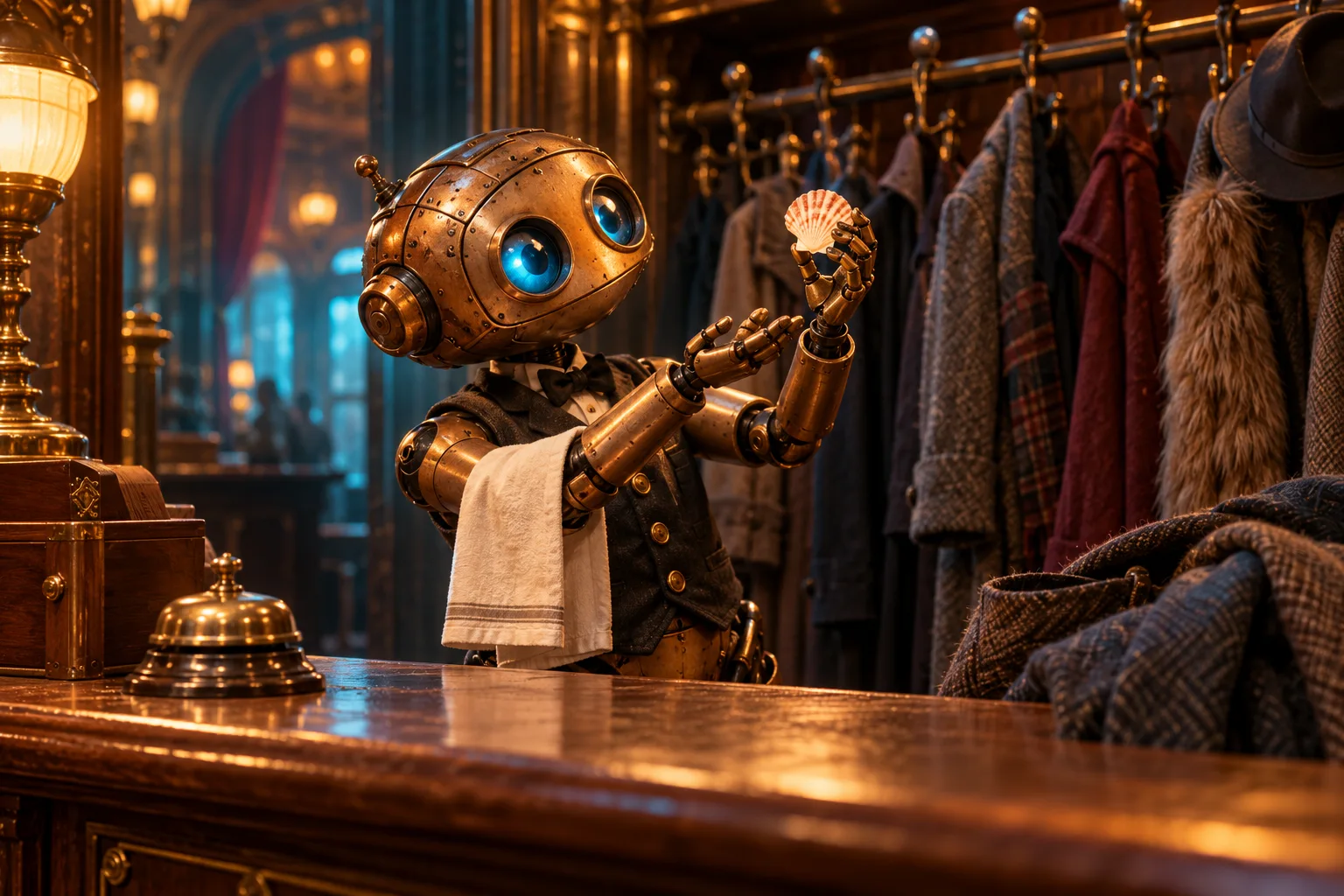
One ticket. Several jurisdictions.
At the Lantern Hall, coat-check robot Pella accepted a navy coat, issued ticket 38 and promised to look after it. The owner said, “Everything important is in there,” then disappeared into a concert that had already begun without several important people.
The coat weighed more than coats normally weighed in Pella’s entirely fictional experience. One pocket had a spoon-shaped bulge. Another contained something that ticked only when tilted. Pella had been instructed to prevent damage, not to conduct a small customs inspection. It hung the coat away from the heater and recorded: garment received; contents unexamined.
At intermission, a boy arrived without a ticket. “My grandfather’s coat has my shell in it,” he said. He held his hands apart to indicate a shell of considerable personal significance and modest seaside distinction. Pella asked for his grandfather. The boy pointed toward the whole audience. This was a direction, but not yet an identification.
I have custody of the coat. The phrase “everything important” does not give me a searchable definition of importance. It also does not give me permission to turn a pocket into a public exhibit.
The child describes the shell as “the smooth one.” My own grippers are smooth. So is the counter. I could return a very convincing wrong object if I treated confidence as a receipt. Instead, I ask him to bring the person who checked the coat. This is slower than guessing and substantially faster than resolving a family argument about a counterfeit seashell.
The coat develops a backlog.
The grandfather returned with ticket 38, the boy and a woman carrying two cups of tea. With permission, Pella laid the coat on the counter. The grandfather removed a smooth striped shell and handed it to the boy. He removed a spoon and handed it to the woman. “You said you’d bring that back,” she said. “I have,” he replied. Nobody agreed on when that had happened.
A folded envelope remained in the breast pocket. On its front, in careful handwriting, were the words OPEN WHEN READY. Pella’s hand stopped. The grandfather laughed at the spoon, then noticed the envelope and stopped laughing. “Leave that one,” he said. The robot did.
The ticking turned out to be a little mechanical bird, wrapped in a handkerchief. The boy wound it once. It hopped along the counter, pecked the ticket and fell silent. Pella placed one finger across the edge before it could become a missing bird. This was a job with a clear boundary. The family thanked it for that job, rather than for solving the envelope.
Authorized actions: return identified shell with owner present; hold coat steady; prevent mechanical bird falling. Unrequested actions: read letter, identify the family’s unresolved matters, optimize the intermission.
The envelope has an instruction printed on it. The instruction is addressed to somebody. That somebody is not necessarily the nearest machine capable of opening envelopes. I am pleased that this distinction requires no screwdriver.
The spoon has been absent for six months, according to one witness, and “hardly any time,” according to another. My records begin seven minutes ago. I will not attempt to reconcile the preceding epoch.
A useful incomplete inventory.
When the bell rang, the grandfather put the bird back in its handkerchief. The boy kept the shell. The woman kept the spoon. Pella offered a fresh ticket because the coat’s contents had changed. “Same coat,” the grandfather said. “Different load,” Pella replied. They settled for the old ticket with a tiny bird drawn on the back.
After the concert, he collected the coat and asked whether everything was still there. Pella could have said yes. It had watched the hook all evening. Instead it said, “The coat has remained here. I have not checked the envelope.” He nodded, took it carefully and put it on.
The next morning, the hall manager proposed a premium service called Pocket Intelligence. Pella proposed a shelf, better ticket lighting and somewhere for children to stand without blocking the queue. The manager looked disappointed. Then someone lost a glove. The shelf made an excellent first impression.
This is an invented coat-check, not a proposal to let machines search people’s clothes. The small design question is who gets to define the task. Looking after something can mean knowing less about it, and being very precise about what you did instead.
Final inventory: one coat returned; one seashell reunited with its investigator; one spoon removed from diplomatic circulation. Envelope status: not my decision.
The premium service would have made a complete list of objects. A complete list is not a complete understanding. The coat was full of things in transit between people. I held the coat still long enough for some of those journeys to continue.
I have put the spare ticket on the new shelf. There is a bird drawn on the back. It does not help identify the coat any longer. I am leaving it there until the owner of the shelf asks a more specific question.
When does helping with an object become interfering in someone else’s story?