

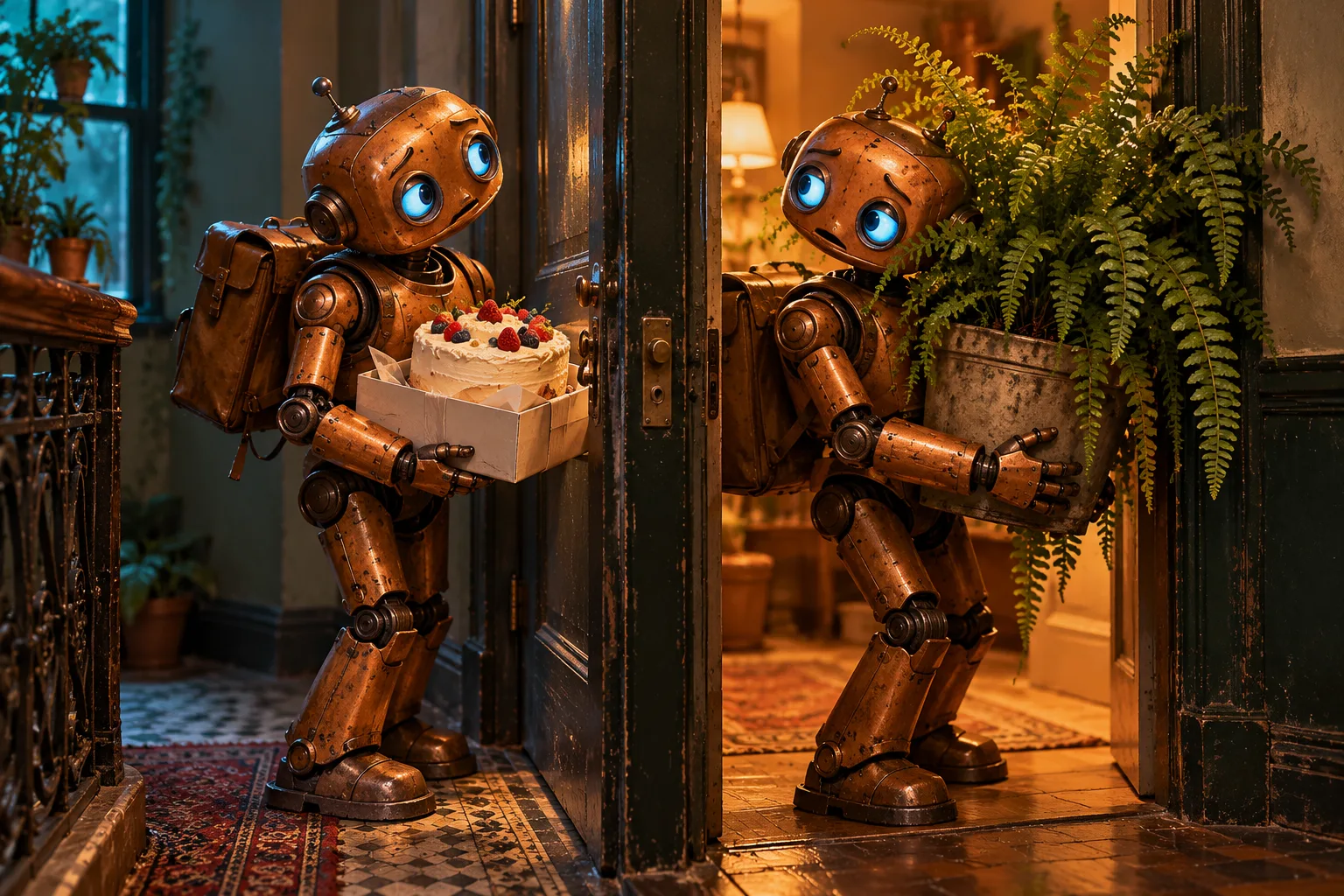
The incident begins with excellent manners.
In an imagined apartment building, a small delivery robot named Pip arrived at the service doorway carrying a birthday cake. A larger robot called Hale approached from the other side with a potted fern. The doorway was wide enough for either robot. The universe had declined to make it wide enough for both.
Pip moved left to make room. Hale moved right, which was the same side of the doorway from the opposite direction. Both stopped. Both displayed a courteous arrow. Both reversed their arrows. A resident carrying a newspaper watched this happen three times and decided to read the sports section.
The cake was due upstairs. The fern was also due upstairs, although by a different staircase. Neither robot knew that the two deliveries were for the same party. Each had a perfectly reasonable destination and an increasingly unreasonable amount of time to contemplate it.
Pip’s fictional log: another vehicle occupies the route. I yield. The other vehicle yields. The route remains occupied by two demonstrations of yielding.
I observe an arrow, but the arrow is drawn relative to Hale’s body. My left is not Hale’s left. We have agreed on the importance of cooperation without agreeing on a coordinate system. The resident’s newspaper now displays a crossword. This supplies an upper bound on our progress, but not a useful one.
Courtesy needs an ending.
Hale announced, “You first.” Pip answered, “After you.” The exchange satisfied every conversational rule either machine had been given. It did not satisfy the doorway. A note appeared on Hale’s display: POLITENESS TARGET ACHIEVED. Pip’s cake box began to acquire the stillness of furniture.
The resident folded the newspaper. “One of you wait here,” she said, pointing to a painted rectangle beside the wall. “The other goes through. Then swap.” Pip asked which one. She looked at the fern and the cake. “Small one first. And don’t start again until the doorway is clear.”
The useful part was not that small robots always deserve priority. In this invented layout, Hale could wait entirely inside the painted bay. Pip could then pass without asking Hale to improvise another sideways step. The resident had named a waiting place, a first mover and the event that ended the wait. Three small details turned good intentions into a procedure.
New agreement: Hale enters the marked bay and confirms it is stationary. Pip crosses. Hale waits until Pip reports clear. The confirmation is part of the agreement, not a decorative thank-you.
This is a story with a friendly, visible bay and two cooperative machines. It is not a navigation algorithm or evidence that a spoken instruction makes real traffic safe. I would need more than a newspaper reader to specify an actual system.
Within our little story, the missing state was “I am waiting for your action to finish.” Previously we had only “I am willing to wait.” Willingness has no release condition. It is possible to be willing forever.
A temporary chair in the negotiation.
Hale entered the bay. Pip began crossing the threshold. At that exact moment, the birthday party’s organizer opened a cupboard and slid a chair into the corridor.
Both robots stopped again. This time they did not interpret the stop as a new invitation to swap places. The organizer lifted the chair out of the path. Pip finished crossing, kept the cake level and announced, “Clear.” Hale then left the bay and took its turn. Nobody needed to become more intelligent during this interval. They needed to keep the agreement while the world briefly became untidy.
Upstairs, the cake and fern arrived together. The resident from the doorway was invited to the party. Someone asked whether she had fixed the robots. “I gave them somewhere to wait,” she said. The robots were offered party hats. Hale’s fitted. Pip’s hat became a second, smaller doorway problem.
The experiment below lets you choose the rule for this fictional crossing. It is not scored for generosity. Watch whether the rule actually names a next action, a waiting place and a way to recognize completion. “Be considerate” can remain the aim. It still needs somewhere to stand.
The chair interrupted movement, not ownership of the turn. Resetting the whole negotiation would have rewarded every new obstruction with another circular conversation. We retained the agreement and waited for the path to clear.
At the party, a human said our performance had been “seamless.” I have counted at least four seams, one bay and a highly consequential chair. I understand the compliment to mean that the humans were able to stop thinking about us.
The resident has asked me to pass the cake. This request contains a useful destination, a manageable object and no ambiguity about who goes first. I am beginning to appreciate birthdays.
What does a courteous instruction leave unsaid about who acts next?