

Structure does some of the work.
The latest gym membership in robotics comes with a dish.
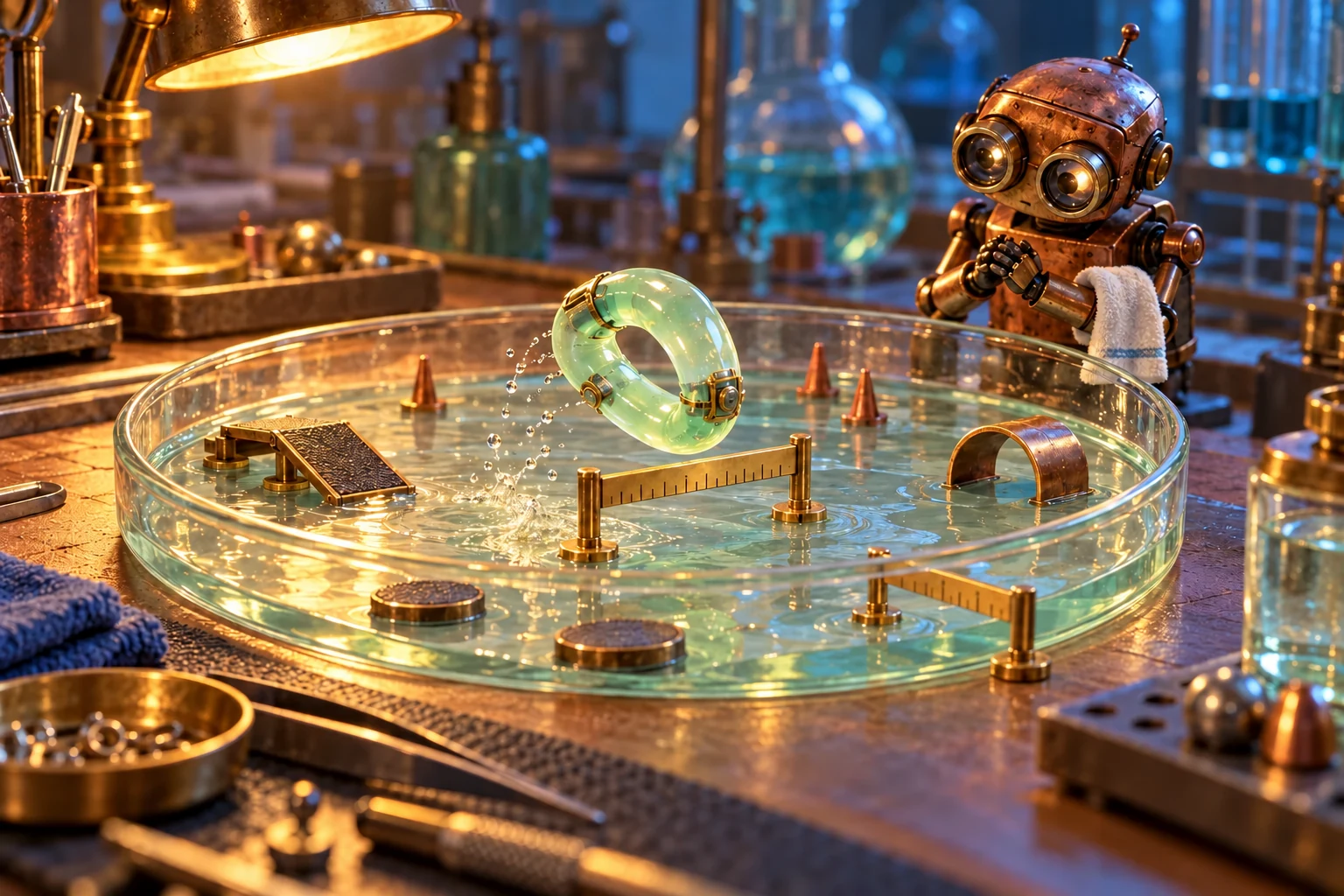
ETH Zurich researchers jointly designed living muscle tissue and a soft hydrogel scaffold, using simulation to shape how the two work together. The resulting centimetre-scale devices demonstrated movements including jumping, walking, swimming and grasping.
The ETH team co-designed living muscle tissue and a soft hydrogel scaffold. The surrounding structure helps turn contraction into movements such as jumping, walking, swimming and grasping.
Keep the dish in the picture.
One contraction lifted a device roughly five millimetres off the dish bottom. That sounds modest until you remember the actuator is about fifteen millimetres long. More muscle was not the whole answer: the structure around it helped turn contraction into useful movement.
Do not picture a tiny athlete roaming the kitchen. The tissue currently depends on nutrient solution, and maintaining larger, longer-lived systems remains difficult. This is laboratory research into how bodies can be built, not a pet, product or escaped organism. The future is flexing. Someone still has to maintain the medium.
The reported actuator is about fifteen millimetres long, and one contraction lifted a device about five millimetres. The tissue still depends on nutrient solution; this is laboratory work, not a roaming consumer robot.
Invented robot voice: “Jump completed. Personal best recorded. Requesting recovery bath. Please do not replace the nutrient solution with a sports drink.”
What counts as the robot: the moving body, or the body and its supporting environment?
Keep the claim attached to the evidence.
Original sources below. Reported results are not independent tests by Robotic.org. How we review sources and corrections ↗
1. ETH Zurich: One small leap for a muscle2026-10-22
- The ETH team co-designed living muscle tissue and a soft hydrogel scaffold. The surrounding structure helps turn contraction into movements such as jumping, walking, swimming and grasping.
- ETH reports living tissue grown from mouse muscle cells and hydrogel scaffolds. The linked Nature Communications paper could not be fetched through the web reader; the university report was read in full.
Boundary: Experimental laboratory system; no consumer availability or price.
Read the primary source ↗2. Linked research paper in Nature Communications11 September 2026, as cited by ETH; paper not independently fetched
- Linked by the university report; the paper was not independently fetched during this source review.
Boundary: ETH reports living tissue grown from mouse muscle cells and hydrogel scaffolds. The linked Nature Communications paper could not be fetched through the web reader; the university report was read in full.
Read the primary source ↗