

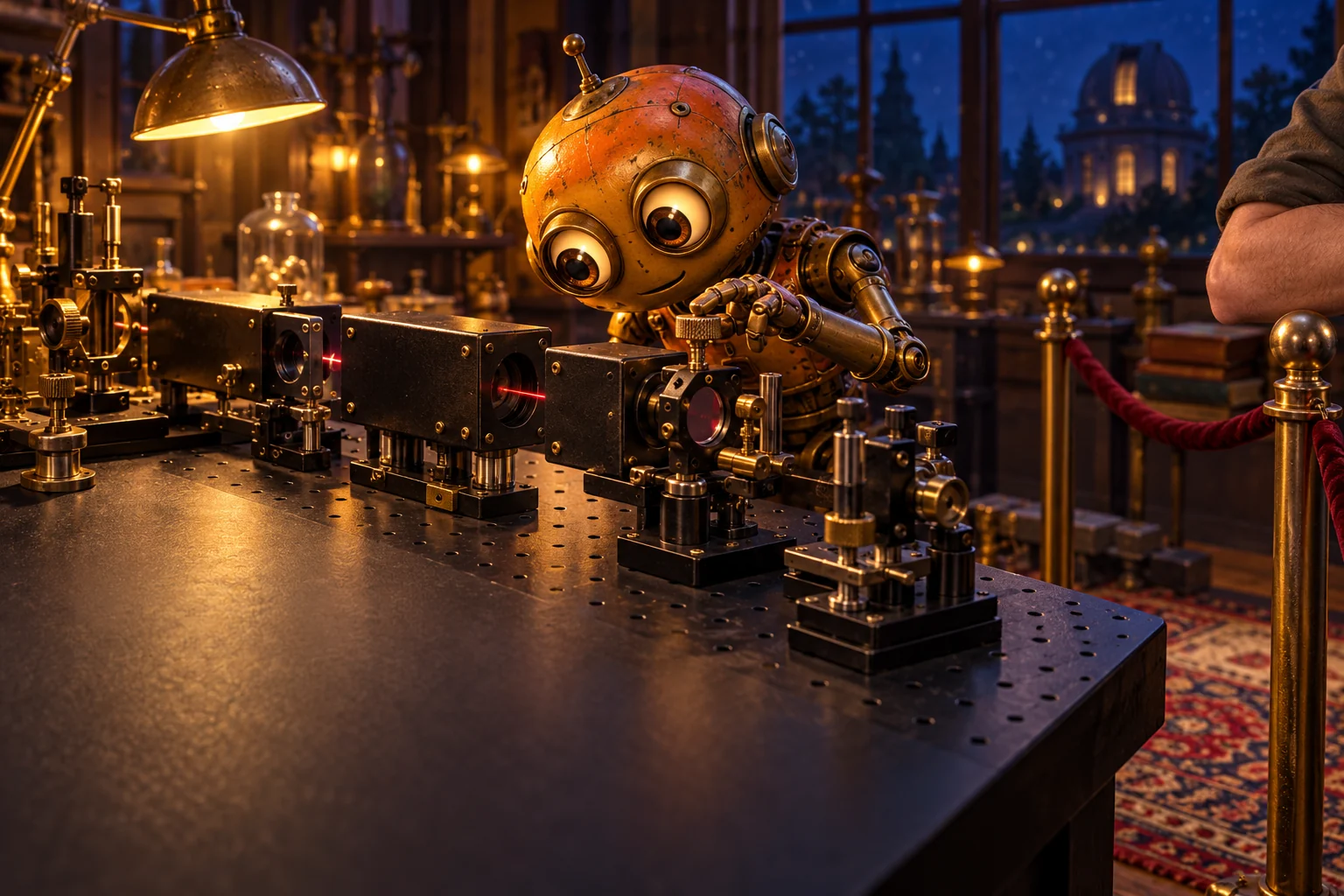
The mirror moved.
Some experiments fail because the theory is wrong. Others fail because a mirror moved by a tiny, deeply irritating amount.
An MIT-led team built a robotic optics system that arranges components, fine-tunes alignment and responds when the arrangement is disturbed. In one demonstration it assembled a working laser cavity through 50 maneuvers in 30 minutes.
The MIT-led system assembles and aligns purpose-made optical components using feedback. One reported laser-cavity demonstration required 50 maneuvers over 30 minutes.
A precise system, not every laboratory.
The system combines a robot arm, purpose-made component housings, cameras and adjustment tools. Those supporting pieces matter: this is a carefully engineered laboratory, not a general robot casually borrowing the science department.
The work appeared as a March preprint and in a September MIT report. A remote-control interface was demonstrated. Public remote access and broader autonomous laboratories remain development goals, not a service already open for bookings. For now, the promising bit is wonderfully unglamorous: a robot doing the precise adjustments again, and again, without making the graduate student do all of them.
Supporting hardware and component housings are part of the achievement. The March preprint and September report do not establish universal experiment design or a publicly bookable laboratory.
Invented robot voice: “Alignment restored. Human moved chair. Alignment restored. Human expressed enthusiasm using elbows. Revising the enthusiasm perimeter.”
Which repetitive adjustment would you most want a robot to take over?
Keep the claim attached to the evidence.
Original sources below. Reported results are not independent tests by Robotic.org. How we review sources and corrections ↗
1. MIT: Robotic lab runs optics experiments on demand2026-09-17
- The MIT-led system assembles and aligns purpose-made optical components using feedback. One reported laser-cavity demonstration required 50 maneuvers over 30 minutes.
- The paper demonstrates closed-loop assembly, alignment and recovery. Do not claim autonomous scientific discovery, universal experiment design or a currently bookable cloud laboratory.
Boundary: Research system, not a consumer product or verified public service; price not applicable.
Read the primary source ↗2. A Framework for Closed-Loop Robotic Assembly, Alignment and Self-Recovery of Precision Optical Systems2026-03-23
- The MIT-led system assembles and aligns purpose-made optical components using feedback. One reported laser-cavity demonstration required 50 maneuvers over 30 minutes.
- The paper demonstrates closed-loop assembly, alignment and recovery. Do not claim autonomous scientific discovery, universal experiment design or a currently bookable cloud laboratory.
Boundary: Research system, not a consumer product or verified public service; price not applicable.
Read the primary source ↗