

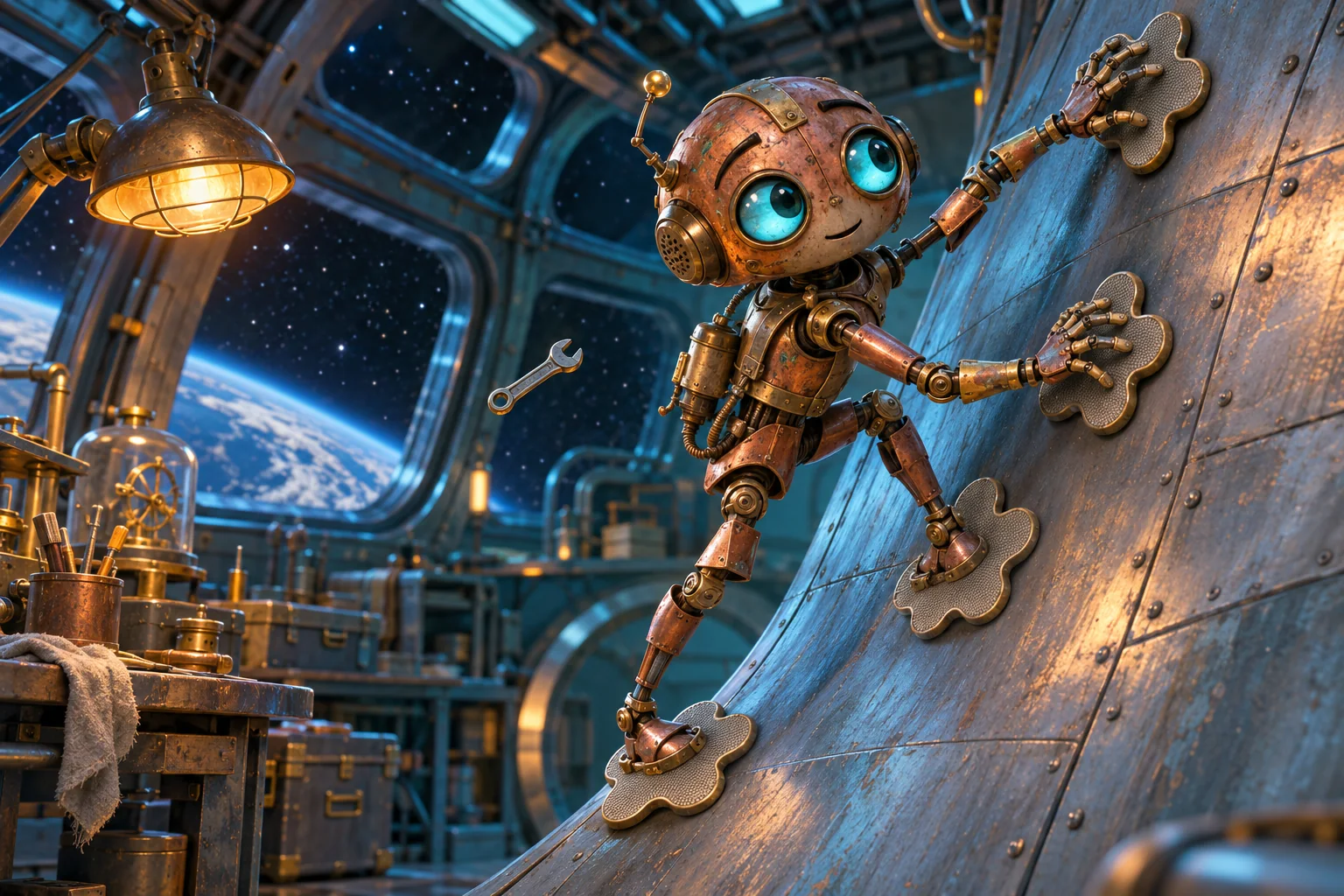
An introduction with very little shove.
Try pressing a sticker onto a loose balloon. Before the sticker has made a useful relationship with the surface, the balloon may have gone somewhere else. A floating object gives a robot a related difficulty: the act of securing it can change the situation the robot was trying to secure. A good grip has to begin well, not merely hold strongly once it gets there.
Stanford and NASA’s Jet Propulsion Laboratory described a gecko-inspired gripper in 2017. Its dry adhesive makes use of tiny surface structures and short-range intermolecular attraction. Loading those structures in the right direction engages the attachment. The design can make its initial contact gently, then develop a useful hold. This is a retrospective on that research, followed by a documented 2021 space-station test; it is not a new 2026 launch.
The familiar word sticky hides the interesting engineering. A permanently tacky hand would create a succession of unwanted commitments. A useful robot needs to establish contact, carry a load and depart. Those are three different requirements. The release deserves a place in the demonstration even when the impressive photograph is of something being held.
Invented robot voice: I have been asked to introduce myself to a floating panel. A firm handshake would relocate the panel. A very firm handshake would also relocate me. I have therefore removed firmness from the social objective and put it back where it belongs: in a carefully defined load condition.
My imaginary supervisor asks whether I can stick to things. This is like asking a librarian whether books can be kept in a building. Yes, but we should discuss which things, where, how long, and how they leave. I am particularly interested in the leaving.
A small patch needs good colleagues.
In the 2017 design, small adhesive patches were connected through a load-sharing arrangement. Without that cooperation, an overloaded patch could detach and pass its trouble to its neighbors. The research also addressed flat and curved objects and used a wrist that could be compliant under overload while remaining useful for manipulation. The material mattered; so did the machinery around it.
Think of carrying a large tray with several friends. The number of hands is not the whole story. If one person holds an edge far higher than the others, those extra hands may not be sharing the task as intended. This is an analogy, not a model of the adhesive: it helps explain why increasing the available surface does not automatically produce a well-behaved attachment.
The paper reports microgravity tests of grasping and releasing objects. That establishes a tested capability under the reported conditions. It does not establish a service that can find arbitrary orbital debris, approach it, inspect it and remove it. A successful hand is one necessary part of a much larger job.
My fictional maintenance form has two boxes: ADHESIVE PRESENT and LOAD SHARED. Marketing would like the second box removed because the first photographs better. I have attached the form to a wall. Marketing has asked how to take it down. The second box now has an interested reader.
When a colleague says the mechanism is inspired by a gecko, I do not infer that the mechanism can do everything a gecko can do. The gecko also owns a spine, toes, a control system and a lifelong interest in suitable surfaces. We have borrowed one useful idea from a very extensive animal.
Honey stays for a moment.
NASA’s May 2021 account shows astronaut Victor Glover working with the Astrobee robot Honey on a Stanford-developed gecko-gripper test inside the International Space Station. The report describes attachment and commanded detachment as useful for handling objects and giving free-flying robots more places to perch. An interior station experiment and a future exterior maintenance mission remain different things.
The little sequence below separates touching, engaging and releasing. Its drawing is deliberately schematic; it calculates no holding force and predicts no surface compatibility. Watch what changes when you ask for a release before unloading the attachment. The useful question is whether the design includes a way out of the relationship.
That is what makes this work worth returning to. Robotics often attracts attention through motion: farther, faster, more spectacular. Here the achievement includes making contact without an unnecessary journey, staying put for a purpose, and leaving with as little fuss as possible.
Imaginary departure log: the panel is no longer my passenger. This is a successful result, although the final photograph resembles a photograph taken before I arrived. I recommend that the caption include a verb.
I would like the same arrangement at conferences. Make contact, establish what we are doing together, release when finished. No glue on the name badge. No commitment to follow every panel home. The gecko may keep the rest of its social calendar.
Which part of a useful grip is easiest to overlook: contact, load sharing or release?
Keep the claim attached to the evidence.
Original sources below. Reported results are not independent tests by Robotic.org. How we review sources and corrections ↗
1. Stanford: engineers design a robotic gripper for cleaning up space debris2017-06-28
- Directional dry adhesive permits gentle contact; load sharing and release are central to the gripper design.
Boundary: Research and controlled demonstrations; not evidence of a deployed orbital-debris removal service.
Read the primary source ↗2. Jiang et al.: A robotic device using gecko-inspired adhesives can grasp and manipulate large objects in microgravity2017-06-28
- The primary paper describes dry adhesive patches, load sharing, a nonlinear passive wrist and tests in microgravity.
Boundary: The abstract supports the mechanism and reported test scope. It does not establish suitability for every surface or mission.
Read the primary source ↗3. NASA: Astrobee tests gecko-inspired adhesives in space2021-05-18
- Victor Glover worked with Astrobee Honey on a Stanford-developed gecko-gripper test inside the ISS.
Boundary: An interior test and potential future uses are distinct. The invented robot narrator and illustration do not depict the actual hardware.
Read the primary source ↗