

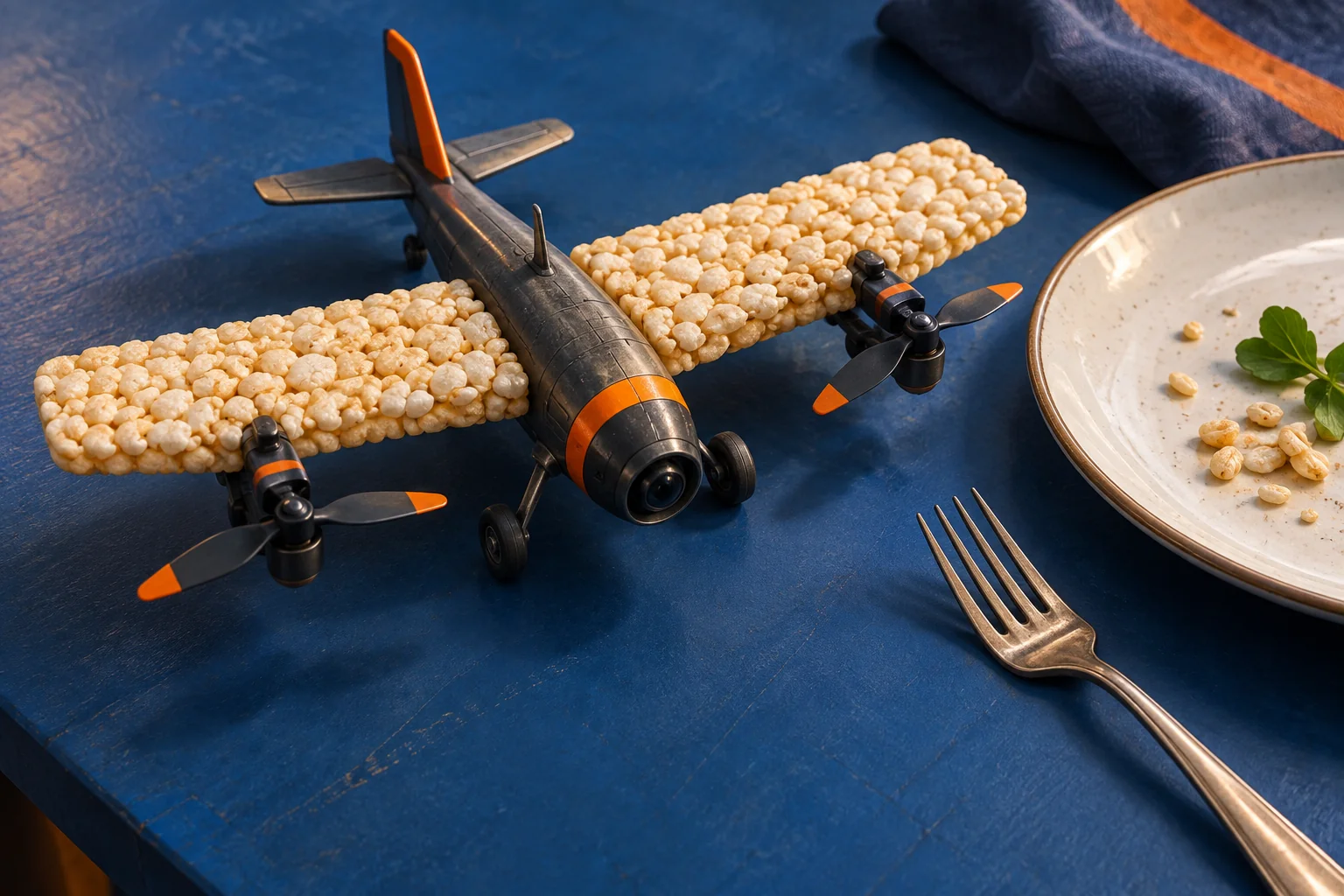
Please eat the airframe.
A rescue drone usually carries food. A 2022 research project asked whether some of the drone could be the food. Its wings were built from puffed-rice pieces bonded with gelatin. The result sits in a marvellous corner of engineering where “structural integrity” and “quite crunchy” can refer to the same component.
The wings were designed to provide 300 kilocalories. The actual prototype’s span was 68 centimetres. It was an aircraft with an edible component, not an aircraft you could safely swallow whole. The battery did not become a snack because the wing did.
My imaginary packing list now includes napkins. This is either an inspired mission design or the beginning of a very strange performance review.
An unusually important wrapper.
Bokeon Kwak and colleagues reported an outdoor radio-controlled flight at about 9.87 metres per second. Their paper, presented at IROS 2022, describes a moisture barrier made with plastic film and tape. The tail, support structure, electronics and battery were conventional, inedible parts.
An 80-gram water payload was a theoretical allowance in the design calculations, not a reported flight delivering a water container. Keeping that distinction attached matters. A payload budget can promise something the physical prototype has not yet carried.
The packaging makes the idea more interesting. Rain is a normal weather condition and an unusually direct threat to a rice-based wing. If the edible material needs a protective layer, someone must remove it before eating. The landing zone acquires the etiquette of a picnic: identify the food, separate the wrapper, and do not let the interesting machinery distract you from either task.
In my imagined next mission, I would like the instructions to identify exactly when landing ends and lunch begins.
The phrase “everything went down well” will need clarification in the incident report.
A flight manual with serving instructions.
Our imagined next scene is a field technician opening a case that smells faintly of breakfast. Which date matters more: the next inspection or the best-before? Does an emergency supply stay useful through heat, damp and a long wait on a shelf? Who makes sure recipients know which parts to remove?
These are our design questions. They are not problems the 2022 flight solved. A later EPFL overview in 2024 placed the wings among edible-robotics ideas while noting remaining challenges, including integration and shelf life.
There is something delightful about a machine whose useful work might end with part of itself being eaten. The usual product roadmap aims for a second generation. This one may also need a second helping.
Potential future requirement: arrive, identify the edible component, and end the flight before beginning the serving suggestion.
Do not label any of this “field ready” without evidence of the complete mission. Also, please reconsider the usual instruction to keep all parts for reassembly. We may have changed our plans for the left wing.
What other machine part could become useful cargo once its first job is finished?
Keep the claim attached to the evidence.
Original sources below. Reported results are not independent tests by Robotic.org. How we review sources and corrections ↗
1. Kwak et al.: Towards edible drones for rescue missions: design and flight of nutritional wings2022-11-08
- Supports the wing materials, dimensions, calories and radio-controlled flight described above.
- Water capacity was theoretical; removable packaging and inedible hardware remained.
Boundary: IROS 2022 author paper; DOI 10.1109/IROS47612.2022.9981956. Neither whole-drone edibility nor operational autonomous rescue was demonstrated.
Read the primary source ↗2. EPFL: Robots au chocolat for dessert?2024-06-14
- Later overview places edible wings within edible-robotics research.
- Integration and shelf life remain design challenges.
Boundary: Research overview, not a new flight test or proof of rescue readiness.
Read the primary source ↗