
Make room for the air
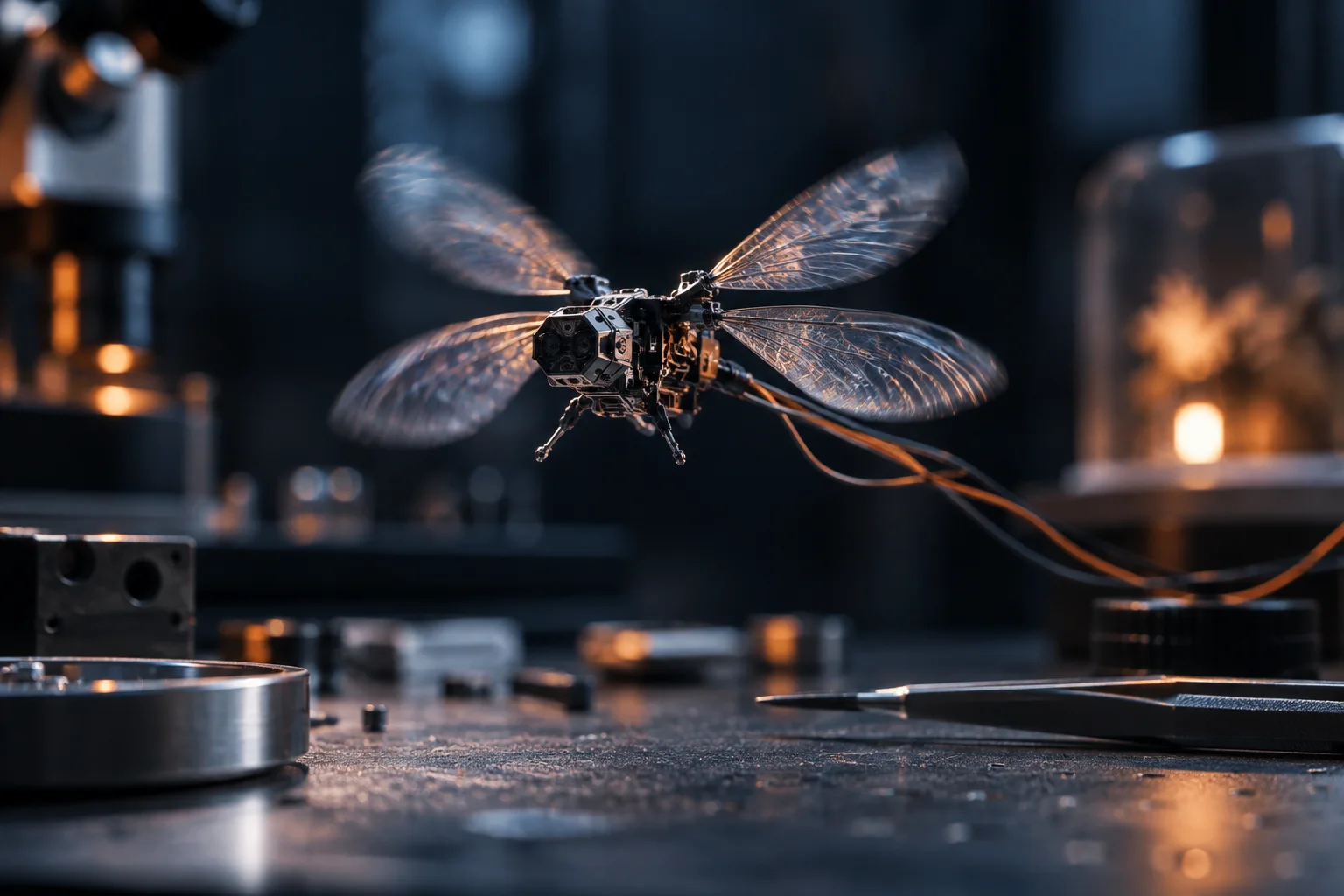
A tiny flying robot makes a very good engineering detective story. The obvious suspects are weight, power, and the wings. But the arrangement of those wings matters too. In MIT’s January 2025 report, a redesign reduced the robot from eight wings to four, each pointing outward. Neighboring wings had been interfering with one another’s airflow.
Soft artificial muscles and revised transmissions supplied the motion while reducing mechanical strain. The lesson is satisfyingly physical: an assembly can behave differently from its individual parts. Four capable wing units still need to cooperate as one aircraft. Sometimes the useful design move is to give the working parts more room.
The January 2025 platform combined four single-wing modules. Dielectric elastomer actuators drove revised transmissions that reduced buckling and strain. The outward wing arrangement reduced aerodynamic interference. This hardware work addressed force generation and mechanical durability; later controller results should be identified separately.
A long hover asks one question
The January study, published in Science Robotics, achieved a 1,000-second hover. Nearly seventeen minutes sounds like a battery specification until you ask what the experiment was measuring. Here, the useful result concerned sustained flight and durability; onboard batteries and sensors remained future work in MIT’s accompanying report.
Try reading a demonstration as a sentence with a few blank spaces: this machine did this task, for this long, with this supporting equipment. Filling those spaces makes the achievement easier to appreciate. Endurance of the mechanism and independence of the whole system are different questions. Both matter. They also invite different experiments, different fixes, and different reasons to be impressed.
The reported hover duration is a supported laboratory result. Treat it as evidence of sustained operation of the flight mechanism. Battery endurance requires an onboard energy source and its associated mass to be included in the tested configuration. The January article describes that integration as future work.
Now ask it to turn sharply
A separate August 2025 preprint tackled agile control on a 750-milligram platform. It reported lateral speed of 197 centimeters per second and ten consecutive flips in eleven seconds. Those moves depended on external motion-capture cameras, a control computer, and a power tether. Fast movement and outside support appeared together in the same experiment.
That is a useful way to look at a spectacular robot video: widen the frame in your mind. Where does its position information come from? Where are the commands calculated? What supplies the energy? These questions reveal the architecture behind the performance. A tiny airborne body can be the most visible component of a much larger machine.
The August 2025 controller study used external sensing, computation, and power. Wingbeat frequency stayed at 330 Hz while voltage commands changed wingbeat amplitudes. Tether forces were themselves disturbances. The reported speed and repeated flips demonstrate performance of this complete experimental setup, including its feedback system.
Bring another piece aboard
A February 2026 preprint moved another part of the system onto a different, 1.29-gram robot: sensing and computation. It also described an operator-directed flight outside motion capture that ended on a sunflower. Those demonstrations used different configurations; the landing does not establish that all computation was onboard for that flight. Onboard power remained a future goal. Keep the dates, bodies and configurations attached to the claims.
The sunflower makes a lovely destination, but the deeper story is the shifting boundary of the machine. A sensing package, a controller, a power supply, and a planner each solve a different problem. Watch those pieces move aboard one by one. That is how a laboratory flyer gradually becomes a more independent system.
The February 2026 study reports onboard sensing and computation on a 1.29-gram platform. Its operator-directed landing demonstration and fully onboard-compute configuration should not be assumed identical: most experiments used sensor boards without the MCU board. High-level planning and power autonomy remained open work. These results must stay separate from the 750-milligram aerobatics platform.
When you watch a tiny robot fly, which invisible helper would you look for first?
Keep the claim attached to the evidence.
Original sources below. Reported results are not independent tests by Robotic.org. How we review sources and corrections ↗
1. MIT News — a more durable robotic insect2025-01-15
- Four-wing redesign; batteries and sensors described as future work.
Boundary: Hover duration is not onboard-battery endurance; batteries and sensors were future work.
Read the primary source ↗2. Science Robotics — Acrobatics at the insect scale2025-01-15
- Revised transmissions and hinges reduced torsional stress and deformation.
- The robot achieved a 1,000-second hovering flight.
Boundary: Mechanical endurance result; sensing and power autonomy remain subsequent research questions.
Read the primary source ↗3. Aerobatic maneuvers in insect-scale flapping-wing aerial robots2025-08-05
- 750 mg platform; 197 cm/s lateral speed; ten flips in eleven seconds.
- External motion capture, computation, and power; 330 Hz wingbeat frequency with amplitude modulation.
Boundary: Cited preprint version describes tethered laboratory experiments.
Read the primary source ↗4. Controlled flight via integrated onboard sensing and computation2026-02-09
- A separate 1.29 g platform demonstrates onboard sensing and computation.
- Human commands directed the sunflower-landing demonstration.
Boundary: Preprint; onboard power remains future work. Experiment configurations differ, so landing must not be described as fully onboard planning and computation.
Read the primary source ↗