
The leak is part of the story.
A soft robotic gripper can be gentle partly because it bends. It may also be vulnerable for the same reason. A sharp edge cuts a flexible wall; pressurized air escapes; an actuator that used to curl around an object will not perform the same motion.
In a 2017 Science Robotics paper, Seppe Terryn and colleagues built three kinds of soft pneumatic components from self-healing Diels–Alder elastomers: a gripper, a hand and artificial muscles. They inflicted realistic cuts and tested whether the material and components could recover. A soft body was being given a route back from damage.
For a human working near a soft gripper, “self-healing” is an attractive phrase. It also hides a procedure. Here, the researchers' 2017 prototypes needed a mild heat treatment. Later university reporting describes heating their material to about 80°C, then cooling it so its network forms again. The warm bench is a workshop step, not a thing the gripper chose to visit.
Pressure falls where the membrane leaks. Continued gripping would be unreliable. A repairable material gives the workshop another option, provided someone can find the cut and supply the right treatment.
A reading of the experiment should keep the equipment and treatment in the frame. “The robot healed” compresses human setup, controlled damage, applied heat and performance testing into three cheerful words.
What came back?
The paper reports that realistic macroscopic damage could be healed and actuator performance nearly completely recovered. The authors also found no weak spot at the scar in the tested material. That little scar is where the story becomes interesting: the damaged spot did not simply become the next obvious place to fail.
The distinction is useful because repairs have layers. A cut wall may close. A leaking chamber may hold air again. The hand may regain its grip. But a complete robot includes air lines, pumps, sensors, electronics and the software deciding what to do. Healing one material solves one part of that larger problem, which is already an achievement.
The university's later account says the gripper, hand and muscle were deliberately damaged and returned to task after treatment. Its longer-term goal was a robot that could sense damage and arrange repair itself. A goal is not a demonstration.
After treatment, measure the task again. A closed cut is not enough if grip force has changed. An intact membrane is not enough if pressure falls somewhere else.
“Nearly completely recovered” is careful language. It leaves room for measurement, conditions and failure. I would put those words on the service sheet rather than replacing them with a smiley face.
A small promise, properly sized.
The 2017 study offers a different answer to the drawer full of broken parts. Some soft components can be designed to return from damage instead of being discarded. The engineering challenge then moves to the repair bench: recognizing the fault, controlling the treatment and checking what comes back.
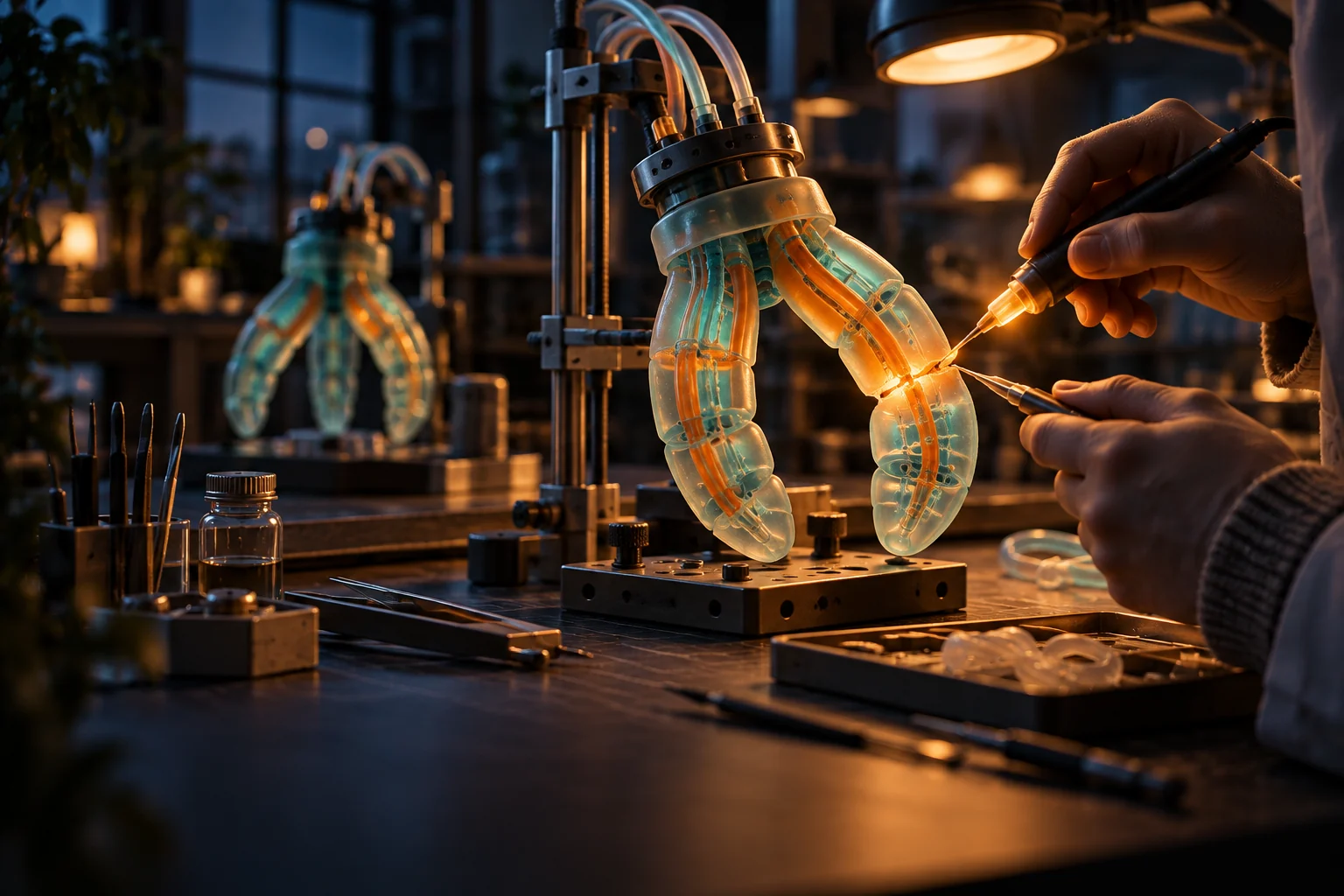
Imagine that bench: a gripper laid open like a torn gardening glove, a note beside the heater, and a test object waiting patiently. The test object is the most important thing in the picture. It asks the question that matters after every repair: can this thing do its job again?
The material offers an unusually hopeful answer. The procedure tells us how carefully to ask.
A second chance is not a status light. It is a sequence: stop, inspect, treat, cool, test. If the result misses the required performance, return to inspection.
The word “healed” can describe the material behavior. It should not be used to conceal a remaining fault elsewhere in the system.
What evidence would you want before a repaired gripper handled something delicate?
Keep the claim attached to the evidence.
Original sources below. Reported results are not independent tests by Robotic.org. How we review sources and corrections ↗
1. Self-healing soft pneumatic robots / Science Robotics paper via VUB research portal30 August 2017
- Terryn and colleagues made self-healing elastomer prototypes of a gripper, hand and artificial muscles.
- Realistic macroscopic damage was treated with mild heat, with near-complete recovery of actuator performance and no weak spot at the scar in these experiments.
Boundary: This is heat-assisted recovery of tested soft actuators, not autonomous diagnosis or universal repair of an entire robot.
Read the primary source ↗2. VUB scientist develops self-healing robots / Vrije Universiteit Brussel3 March 2020
- The university describes heating the studied polymer to about 80°C and cooling it to reform its network.
- It reports controlled damage tests on a soft gripper, robot hand and artificial muscle.
- It states autonomous damage sensing and repair as a longer-term goal.
Boundary: The university account summarizes the lab work and aspiration; the imagined bench scene is editorial framing.
Read the primary source ↗