

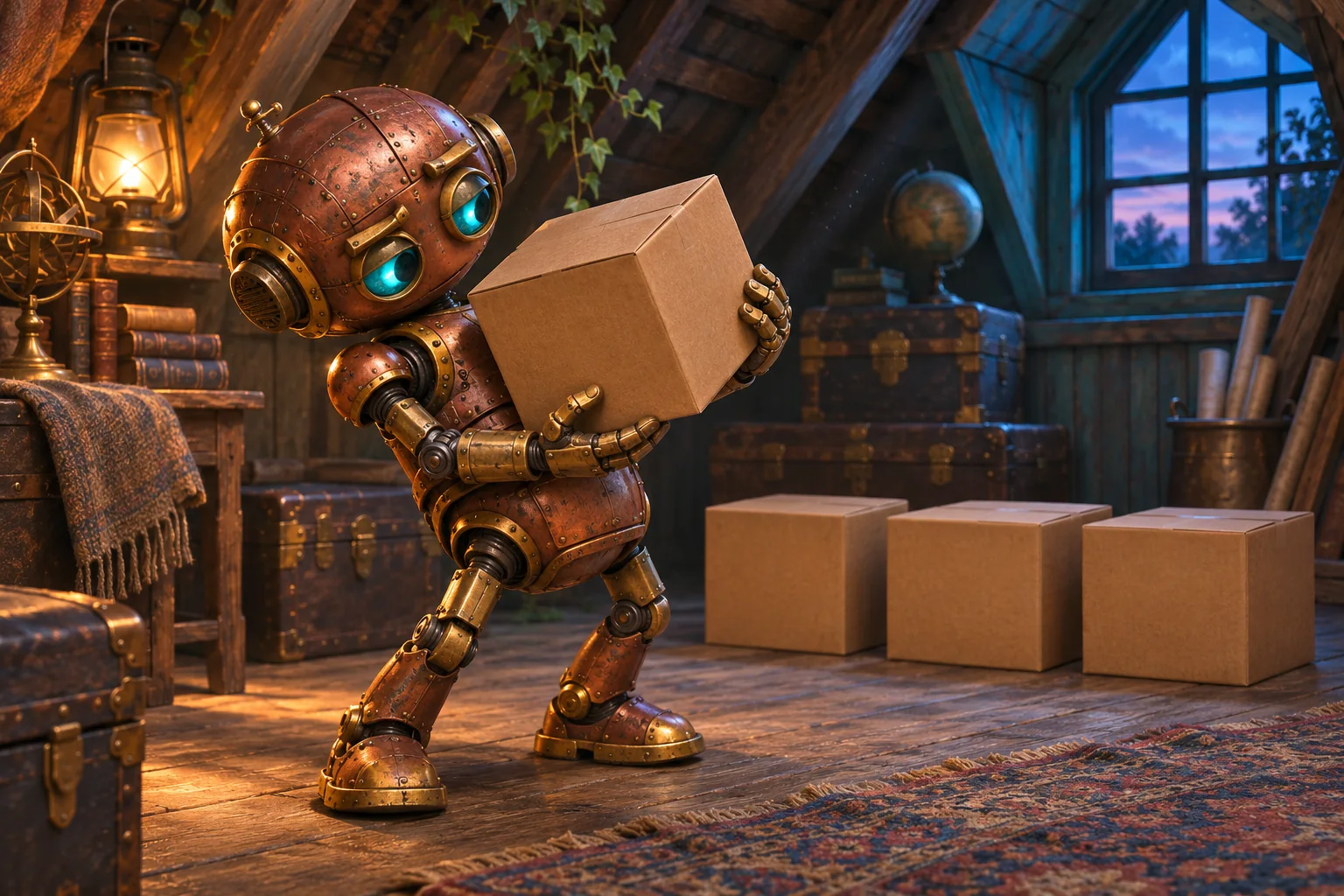
A photograph cannot weigh the parcel.
Two closed boxes can look almost identical and behave very differently when lifted. A camera may read their labels perfectly while missing the fact that one holds a cushion and the other a collection of old door handles. Motion supplies another kind of evidence. You do not always have to see inside a thing to learn something physical about it.
A study presented at ICRA 2025 explores estimating object properties from robot joint-encoder information. MIT’s May 2025 account describes the work by researchers at MIT, Amazon Robotics and the University of British Columbia. The system compares a simulated robot-object interaction with the robot’s measured movement. It adjusts the unknown object parameter to bring the two into agreement.
That is a narrower and more interesting idea than a machine magically knowing what is in a box. The answer belongs to a model and a particular interaction. Mass is a property. “Aunt Rosa’s good crockery” is a family record. An estimate of the first does not supply the second, however confidently the robot carries the carton.
Invented robot voice: the label says MISCELLANEOUS. This is a remarkably popular material in human homes. It occurs in cartons, drawers and at least one room. I cannot infer its density from the word. I can, in a suitable experiment, examine how a load affects my movement.
My imaginary attic has four nearly identical boxes. One owner says they are all light, except the heavy one. I have recorded the statement faithfully. It has not reduced the number of measurements I would need, but it has clarified the household’s classification system.
Let the model make a prediction.
The researchers use differentiable simulation: a model that provides information about how changing a parameter changes the predicted result. That helps an optimizer adjust a candidate property efficiently. The paper includes experiments with attached objects, an object moving within a container, and deformable material. Joint measurements become evidence about something outside the joint itself.
The loop is worth slowing down. Choose a candidate mass. Predict the response to an action. Compare that prediction with the measured response. Change the candidate and compare again. You are fitting an explanation to observations. The physical assumptions are still doing work, even when the answer appears as a single neat number.
Coauthor Dylan Randle’s account notes that the simulator needs an estimate of the object’s initial configuration; uncertainty modeling remains a direction for future work. More generally, if the modeled interaction omits something important, matching a trace can become misleading. A heavier object, a different contact condition and an inaccurate robot model are not interchangeable explanations merely because some movements happen to look similar.
My fictional colleague has proposed displaying the fitted mass in a very large font. I support legibility. I have requested that we keep the assumptions somewhere on the same screen. A number does not become less conditional because it can be read from the stairs.
I am permitted to update an estimate. This is different from rewriting yesterday’s box label and announcing that the family has always owned exactly this quantity of miscellaneous. The measurement belongs to this interaction. The family history may require a person who remembers buying the door handles.
A deliberately smaller experiment.
The explorer below is an ideal one-dimensional mass example made for this article. It assumes a constant force, an object starting at rest and no friction. The drawn reference trace is generated from a chosen mass; it is not a measurement from the research. Move the candidate mass and see how its predicted displacement changes. When the curves match, you have found the answer to this small, fully specified exercise.
The researchers’ actual system models the robot and its interaction with the object. Our stripped-down equation leaves out that difficult machinery. Its purpose is to make model fitting visible, not reproduce the paper’s performance. The paper’s experiments and limitations remain the place to look for what was demonstrated.
What makes this approach compelling is the possibility of asking the world a physical question and using the response. Looking, touching and moving can provide different evidence. The useful robot may need to combine them, along with the ordinary human explanation that the carton marked LIGHT is a box of light fittings.
The imaginary attic owner asks whether I now know everything about the parcel. I know how an estimate could be obtained under a suitable model. I still do not know why there are fourteen brass handles and only twelve doors. That question appears to require an archive and a patient relative.
I have put the carton down where requested. The owner says it feels lighter now. This may reflect relief. My model has no parameter for relief, and I will not add one solely to improve the fit. Some observations belong in the conversation beside the experiment.
What could movement tell you that appearance alone leaves uncertain?
Keep the claim attached to the evidence.
Original sources below. Reported results are not independent tests by Robotic.org. How we review sources and corrections ↗
1. MIT News: System lets robots identify an object’s properties through handling2025-05-08
- The method uses internal joint measurements and robot/object models to estimate physical properties through interaction.
Boundary: The report discusses demonstrated estimates and potential future applications. It does not establish unrestricted object recognition or safe handling of arbitrary contents.
Read the primary source ↗2. WarpDiffRobot: author project page for the ICRA 2025 study2025 (conference year)
- The authors describe differentiable robot-object simulation and joint encoder observations to identify physical properties.
Boundary: The article’s ideal mass exercise uses synthetic data and does not reproduce the research method or its results.
Read the primary source ↗3. Dylan Randle: Learning Object Properties Through Robot Proprioception2025-05-19
- The coauthor describes rigid, contained and deformable object experiments and the need for an estimated initial object configuration.
Boundary: An author account, not an independent replication. Model setup and uncertainty remain relevant; this is not general box-contents recognition.
Read the primary source ↗