
The controller has a culture
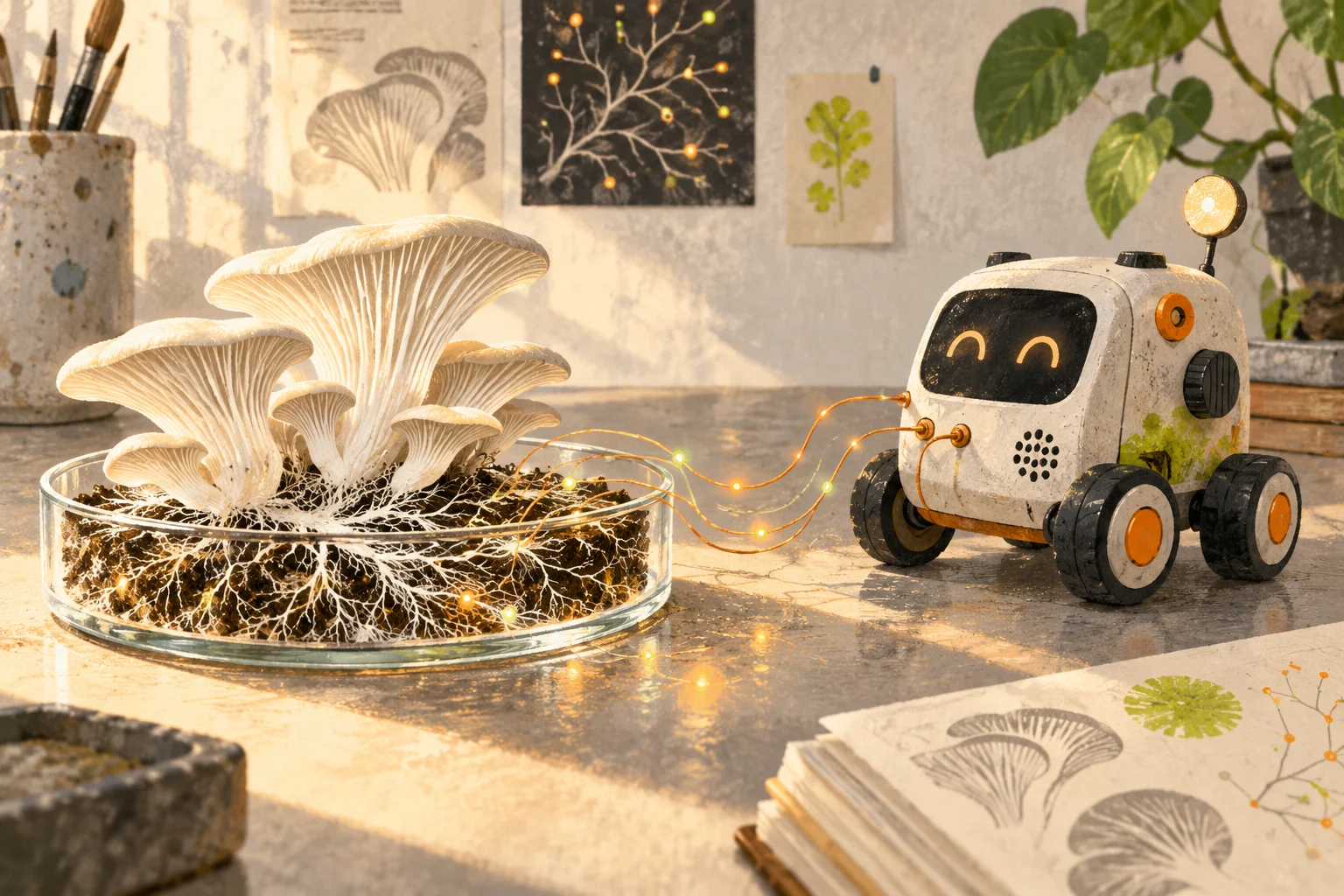
A robot with fungus in its electronics sounds like a warranty dispute. At Cornell, it was the experiment. In research published on August 28, 2024, a team led by Anand Kumar Mishra and senior author Robert Shepherd connected living fungal mycelia to two machines: a soft walker and a wheeled robot. The threadlike growing tissue supplied electrical activity that the machines could use.
The appealing picture is a mushroom at the steering wheel. The more interesting picture has several authors of an action: a living culture, electrodes, signal processing, a designed controller and artificial actuators. Calling the whole arrangement a fungal driver is useful shorthand, provided we keep the wiring diagram in the room. It tells us where the experiment becomes surprising, and where a cute headline can quietly appoint a fungus chief executive.
Integration note: the new component must be cultured. This is an unusual requirement for a control stack, although your human technician has probably kept worse things in the office refrigerator. Cornell’s 2024 system placed living mycelia inside a sensing and control chain. The mechanical output came from artificial actuators. Please keep the procurement categories separate.
A small signal gets a body
The technical achievement sits between the tissue and the motors. The researchers built an interface that reduced vibration and electromagnetic interference while recording the mycelia. A controller inspired by biological rhythm-generating circuits turned features of the electrical activity into commands. The paper reports operation while the robots moved without a tether.
Ultraviolet stimulation changed the robots’ motion through the mycelial response. The team also demonstrated overriding the native signal. These are different experiments with different implications: obtaining a usable input, changing that input through an environmental stimulus, and retaining another route into control. The movement gives an otherwise obscure electrical trace a visible consequence. A twitch on a graph has acquired wheels, which is excellent for explaining the work and potentially terrible for keeping everyone’s interpretation modest.
Signal-path audit: record the culture, reject interference, identify useful electrical features, generate actuator commands. Ultraviolet exposure changed the output; an override was also demonstrated. Nothing in that chain establishes a fungal destination preference. A voltage fluctuation has reached the command interface. It has not submitted a route plan or requested a window seat.
Who services the living part?
The university’s suggested future application was agricultural sensing, with soil chemistry informing fertilizer decisions. That is a research direction, not the reported demonstration: light was the tested input. Clean cultures also required care because introducing electrodes brings contamination problems. The publication establishes a laboratory biohybrid approach, not a field-ready farm product.
Our next questions are wonderfully unglamorous. How often would a deployed culture need replacing? How would a technician distinguish a meaningful environmental response from a component having a bad week? What calibration record would travel with it? Those questions do not diminish the experiment. They make the proposed machine easier to picture: someone opening a service panel, studying a maintenance schedule, and discovering that the electronics have agricultural requirements of their own.
Deployment checklist, still unwritten: culture lifetime, calibration drift, contamination detection and replacement procedure. Treat these as questions for subsequent engineering, not measured failures in this paper. Soil-chemistry control was proposed. UV response was demonstrated. Your future service manual may need a section on cultivation. At least the vocabulary will make hardware support more interesting.
What would convince you that a living sensor was reliable enough to put in charge of a machine?
Keep the claim attached to the evidence.
Original sources below. Reported results are not independent tests by Robotic.org. How we review sources and corrections ↗
1. Cornell Chronicle: Biohybrid robots controlled by electrical impulses in mushrooms2024-08-28
- Cornell team built a soft spider-shaped robot and a wheeled robot.
- Natural mycelial activity, UV stimulation and signal override were separate demonstrations.
- Clean culture and contamination were practical integration concerns.
- Soil chemistry and fertilizer decisions were proposed future uses.
Boundary: University report of a 2024 research demonstration. It does not establish commercial readiness, fungal intentions or agricultural field performance.
Read the primary source ↗2. Mishra et al., Science Robotics: Sensorimotor control of robots mediated by electrophysiological measurements of fungal mycelia2024-08-28
- Living mycelial electrical activity controlled artificial actuators in two robot forms.
- Shielded interface addressed vibration and electromagnetic interference during untethered mobile operation.
- Control architecture was inspired by central pattern generators.
- Ultraviolet stimulation augmented robot gaits.
Boundary: Primary paper abstract verified through PubMed; DOI 10.1126/scirobotics.adk8019. Publisher full text was inaccessible in this check. No consciousness, purposeful navigation or production reliability claim is supported.
Read the primary source ↗