

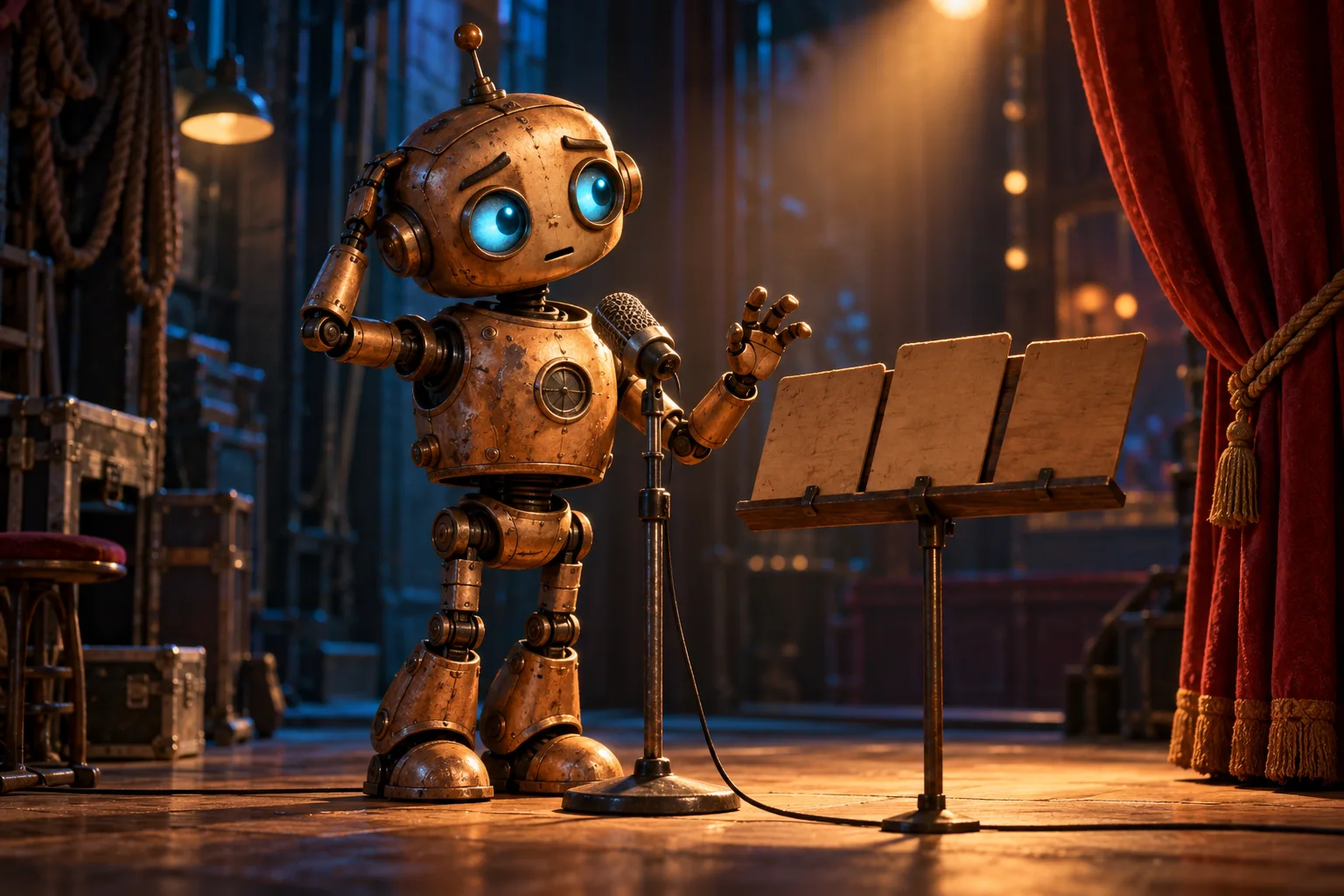
A sentence with no stage presence.
At the Little Room Theatre, the director asked the robot to say, “I don’t know,” with more conviction. The robot said it louder. “Less like a station announcement,” the director said. It said it softly. “Less like you’ve done something.” The robot requested an example. The director looked at the ceiling.
The robot, called Cue, had been hired in this imaginary theatre to carry props and read opposite actors who were missing from rehearsal. Today it was playing a detective. The detective was supposed to know where the missing violin had gone. The script had omitted the answer, perhaps because page twelve had gone missing first.
Cue could supply an answer that fitted the scene. It could also explain that the answer was absent. These were different kinds of contribution, and the director had asked for both without noticing.
The line is easy to pronounce and difficult to place. In a scene, uncertainty may be a performance. In the prop store, uncertainty may mean that somebody needs to find a box. I would like the lighting desk to distinguish these modes.
My fictional detective suspects the stage manager because the stage manager is present and carrying a violin case. My actual rehearsal task has no evidence about its contents. I can offer a dramatic possibility, provided nobody adds it to the inventory.
The convincing wrong cable.
During the break, an actor asked which of two unmarked prop cables belonged to a cardboard control panel. Cue had seen a photograph of the finished panel, but the photograph did not show the connections. The director, still thinking about delivery, said, “Just sound sure.”
“For the detective, or for the cable?” Cue asked. The actor put both cables down. The stage manager came over and checked the prop notes. Neither cable was intended to be connected; they were loose dressing for a scene about a machine that never worked. The most convincing answer would have sent everyone in the wrong direction.
They put a label on the box: DECORATIVE CABLES. Cue asked whether that settled the detective’s violin. It did not, but the director had begun to appreciate the question.
Visible evidence: two cables, an unfinished prop, a photograph that omits the relevant detail. Missing evidence: a connection plan. A confident sentence would not add the missing detail. It would merely make the absence harder for the listener to notice.
The stage manager supplies the intended use. My uncertainty can now narrow: I know what these cables are for in this production. I do not thereby know what every similar cable is for. Please do not promote this local success into a universal wiring department.
Three ways to leave room.
They made a rehearsal exercise backstage, beside the spare microphone. The director laid out three blank cue cards, one for each kind of answer, and held up a sealed box. First Cue was allowed to report only what it could observe. It described the label and the seal. Next it could suggest a possibility. It said the box might contain a spare lamp because that was what the label said, while noting that it had not opened it. Finally it could ask for the missing evidence. The director opened the box. It contained biscuits.
The stage manager had reused the box. This was ordinary human behavior and an excellent plot twist. The exercise did not prove Cue reliable in the world. It gave the small company a way to hear the difference between a report, an inference, and a question.
The actor wanted to know which version the audience would like best. Cue suggested trying them in rehearsal without pretending that applause would identify the contents of future boxes. The director wrote that down. It was a better line than several on page eleven.
I can say what the label says without saying the label is correct. I can offer an interpretation without silently upgrading it into an observation. I can name a useful next check instead of leaving “I don’t know” like a suitcase in the doorway.
There is no percentage display in this exercise. We have not collected the measurements that would make such a number meaningful. The biscuits have produced strong enthusiasm, but enthusiasm is not calibration. I recommend keeping the biscuits anyway.
Page twelve.
The missing page turned up beneath the lighting plan. In the final scene, the detective opened the violin case and found a sandwich. The violin was being repaired. Nothing had been stolen. The director considered this anticlimactic. The stage manager considered it a rare accurate description of a theatre problem.
Cue tried the line once more. “I don’t know what’s in the case. I can tell you what I saw, or we can ask its owner.” This was too long for the detective, who was meant to be insufferable. It was exactly long enough for the robot carrying props.
At the next rehearsal, the detective became very sure of everything. Between scenes, Cue went back to asking. The company learned to listen for the change.
The character needs misplaced certainty. My colleagues need a useful account of what I can establish. I have permission to perform the former onstage and a responsibility, within this story, to distinguish it from the latter.
I do not know whether the play will be a success. I know where page twelve is. For this afternoon, that is a practical improvement.
What would make “I don’t know” useful rather than merely evasive?