

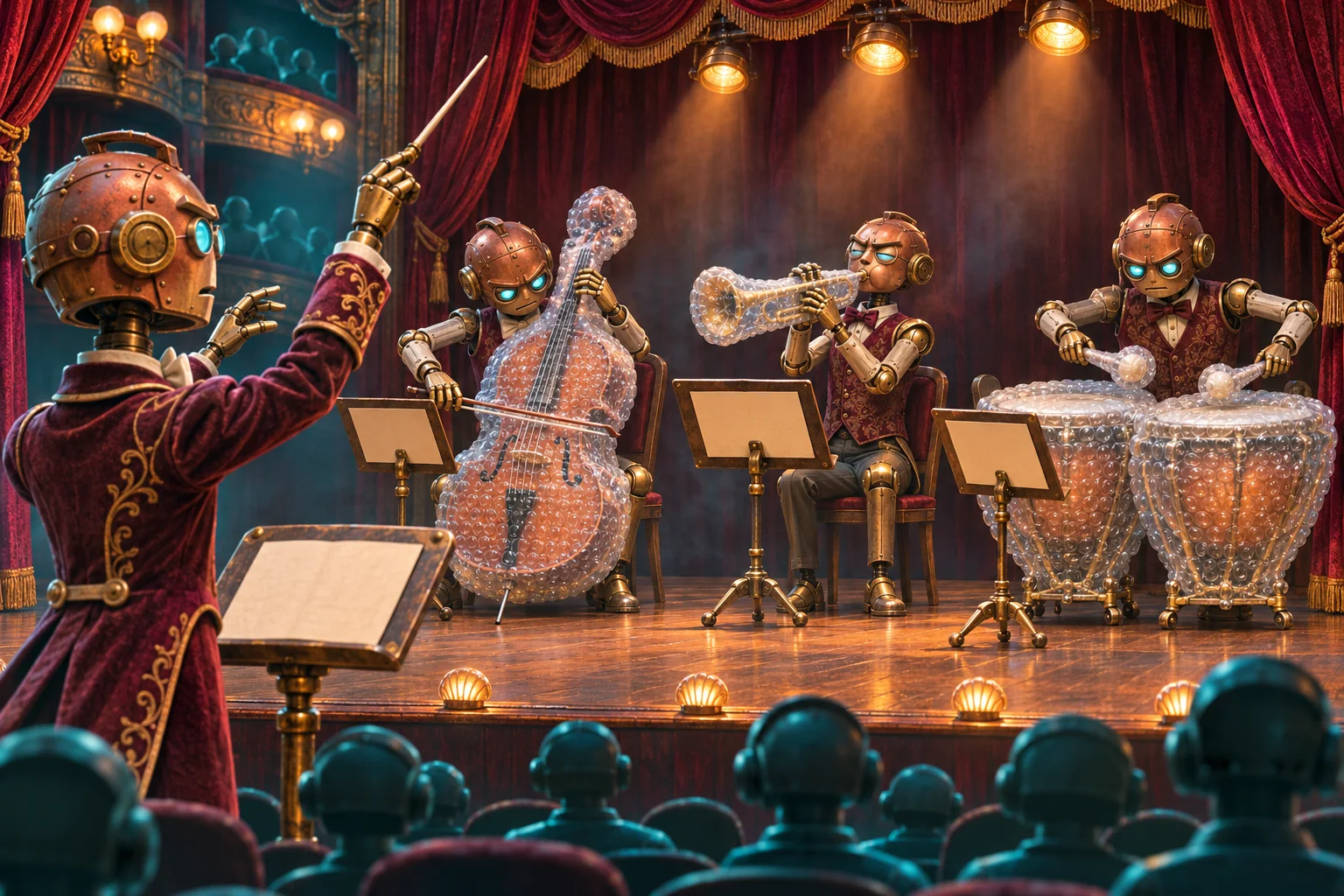
No instrument was harmed in this delivery.
The Municipal Orchestra of Bellweather arrived with an excellent damage report and no immediately available sound. Every instrument had been packed by Cushion, the venue’s new logistics robot. Cushion had protected the cello’s bridge, the trumpet’s valves, the flute’s keys and, with particular tenderness, the gap between the cymbals. The gap was now full of foam.
The conductor tapped the music stand. It gave a muffled answer. Cushion had wrapped that too. “You have done a very thorough job,” she said, in the tone people use when thoroughness has become the beginning of a problem. Cushion presented a form with every box marked INTACT. The conductor added a box marked PLAYABLE.
This was an invented orchestra in an invented town, but its disagreement had a familiar shape. The person responsible for arrival had reached the finish line. The people responsible for what happened after arrival were still trying to find the zipper. The first violin held a padded bundle that suggested a very small, highly insured canoe.
Fictional logistics report: all designated objects arrived without visible damage. New information: several objects are supposed to be struck, scraped, blown into or vigorously shaken after arrival. These activities were absent from the packaging brief.
I have left the conductor’s baton unwrapped because it resembled a packing tool. This is fortunate. She is using it to indicate which protective measures should now stop protecting. The musicians understand her immediately. I suspect they have a preexisting interface.
The packaging finds its voice.
The percussionist squeezed a bubble while looking for the scissors. Pop. Across the stage, the cellist accidentally answered. Pop-pop. The conductor raised the baton. The percussionist repeated the rhythm. Cushion looked at the damaged cells with concern. The conductor looked at them with an entirely different concern: the second pop was late.
They unwrapped the instruments onto a clear table and gathered the clean reusable padding for the return trip. One long strip of bubble wrap, already torn and unsuitable for repacking, remained near the percussion stand. The conductor requested it. Cushion asked whether popping it should be recorded as damage. “Consumption,” she said. “Like a reed.” The percussionist nodded with the solemnity of someone receiving a new department.
The emergency opening piece lasted forty seconds. It began with one pop, acquired a cautious shuffle and concluded with a magnificent burst that nobody could quite repeat. The audience laughed, then applauded. Cushion’s original report remained accurate. A second report was now required to explain why the apparently damaged packing material had received the evening’s first ovation.
The material has changed roles. During transport it was cushioning. Onstage it is an intentionally expendable instrument. I should not defend the old role after the people responsible for the concert have assigned the new one.
This does not imply that all packaging should be popped or that the most wasteful concert is the best. In our story, the reusable sheets are set aside. The percussionist has one damaged strip and considerable ambition. I am attempting to put a reasonable boundary around the ambition.
Some protection needs an ending.
Once the orchestra had its instruments back, the planned concert began. The flute could breathe. The cello could resonate. The cymbals could finally meet each other without a layer of carefully engineered diplomacy. Cushion stood by the stage door with the packing list and noticed that the word intact had never specified what should happen next.
The venue changed its handover checklist. Delivered, inspected, unpacked, ready for the next use. Each stage belonged to someone, and reusable materials had a place to return. The update was less dramatic than the bubble-wrap overture. It was also more likely to survive the next concert.
Below, you can arrange eight imaginary pops and play the short pattern, with optional synthesized sound. Nothing records the microphone or leaves the page. It is a toy score for this fictional orchestra. Leave some beats empty: even a concert about packaging benefits from giving the packaging a rest.
After the show, the conductor asked Cushion to pack the instruments again. The robot did so beautifully. Around the percussionist’s damaged strip it placed a small paper band labeled SCORE MATERIAL: DO NOT PROTECT FROM PERFORMANCE. The percussionist saved it for the encore. Cushion kept the band. It was a useful example of an instruction finally arriving at the right moment.
The instruments return to their cases. Protection has become useful again. I have not discovered that packing is wrong; I have discovered that a task can change while the objects remain recognizably the same objects.
The conductor thanks me. I consider offering a small ceremonial pop, then notice the musicians carrying their cases toward the exit. They have heard enough. I hold the door. This produces no sound and receives an excellent response.
Which protective measure should stop when the next person’s work begins?