
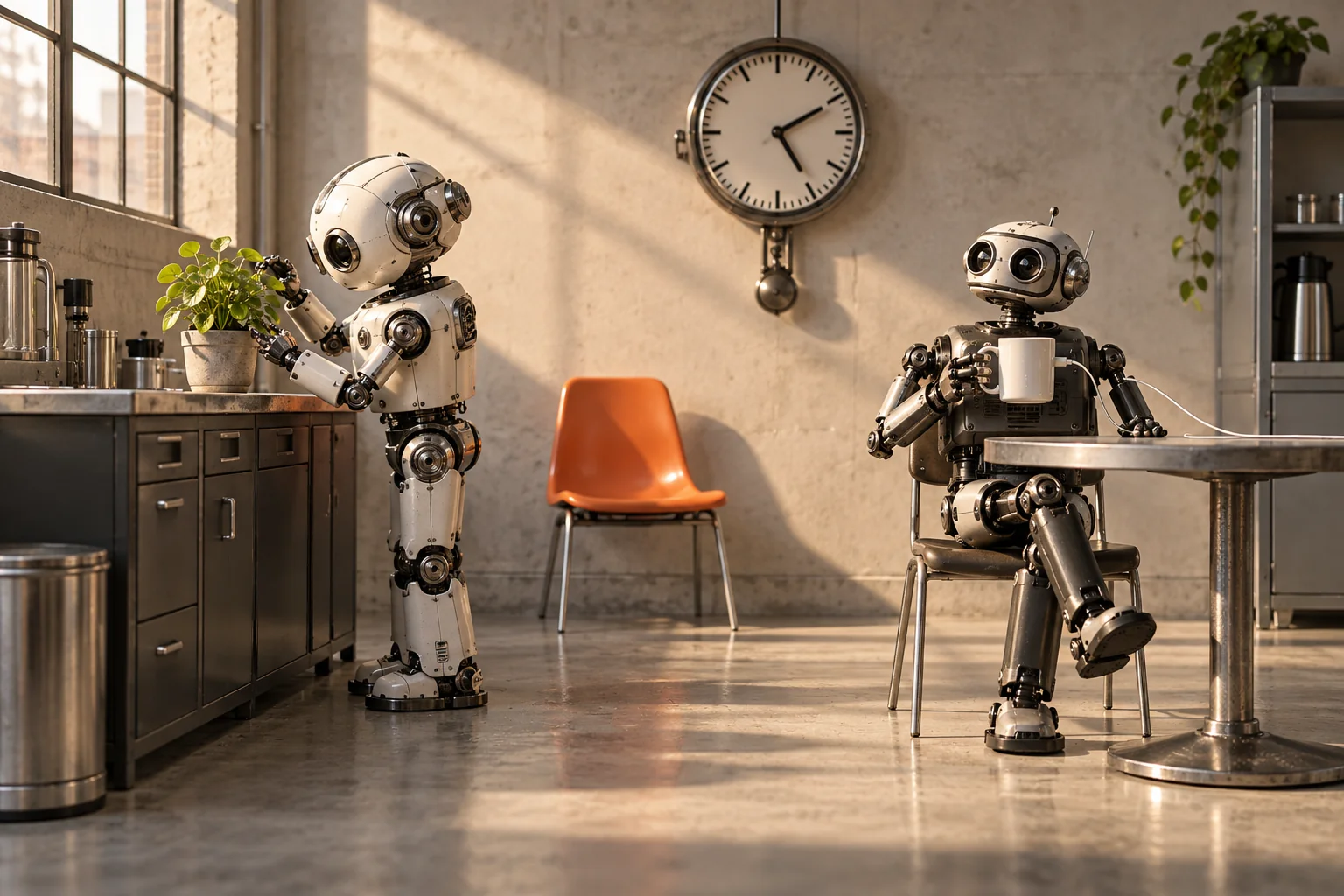
An unscheduled moment.
The room is small enough that turning around counts as a team activity. One robot has a mug. Another has a charging cable disguised as a mug. Nobody has asked the plant what it does here, which is probably why it is thriving.
This imaginary workplace has solved most of the problems that make a robot difficult to build. It has not solved the problem of someone leaving a teaspoon in the sink. That remains a cross-functional initiative.
Below is the noticeboard. Read the small rules and you can reconstruct the incidents that made them necessary. Every organization is, in part, an archive of things somebody thought went without saying.
Break period detected. Task queue temporarily empty. Social queue unexpectedly long.
The plant consumes light, receives water and is permitted to stand motionless beside the window. Its performance review contains the phrase “a calming presence.” I have submitted a request to be evaluated using the same framework.
The chairs have moved since the last map update. Facilities calls this flexibility. Navigation calls it a breaking change. Please do not resolve the disagreement by placing a label on Facilities.
The room between tasks.
The joke is not that robots are bad at being people. It is that a surprisingly large part of being people consists of knowing which instructions nobody intends you to follow precisely.
A good shared space makes some of those hidden rules easier to see. Who may interrupt? What needs permission? When should a machine ask instead of guessing? Those are real design questions, even when the meeting about them is chaired by a kettle.
People say “take a break” but do not provide a termination condition. I have learned that making a second drink often counts as productive uncertainty reduction.
Current room state: two occupants, one excellent plant, no urgent tasks. The correct next action may be to leave the next action unspecified.
What small workplace rule contains the largest hidden story?